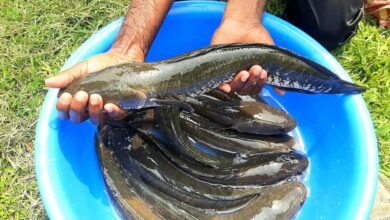
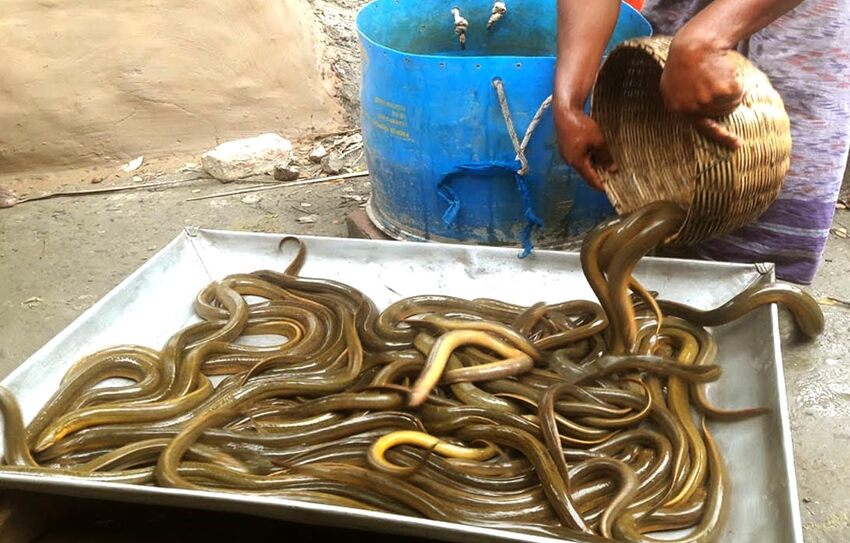
Bangladesh’s rivers, floodplains, haors, beels and wetlands are home to a remarkable diversity of aquatic life. Among these inhabitants, there is a fish that has long remained relatively overlooked in the domestic market but is increasingly finding its way into international trade: the Asian swamp eel (also known as mud eel or rice-field eel and locally called kuchia or kuche in Bengali). It is a distinctive air-breathing, freshwater fish adapted to shallow, muddy environments. For generations, swamp eels have been caught from Bangladesh’s natural water bodies, particularly in areas where they thrive in muddy and shallow aquatic environments. Its domestic demand remains comparatively limited but international markets have created a new economic opportunity for this unconventional fish. Today, live swamp eel is emerging as a promising component of Bangladesh’s fisheries export basket.
Bangladesh has been exporting live swamp eel to international destinations including China, Japan, South Korea, Hong Kong, Thailand and Taiwan. According to the Department of Fisheries, Bangladesh exported 8,408 metric tonnes of live swamp eel (kuchia) in the 2024–25 fiscal year, generating export earnings of BDT 398 crore. In the preceding 2023–24 fiscal year, exports amounted to 17,438 metric tonnes, with an export value of BDT 993.71 crore. In addition, 12,108 metric tonnes of live swamp eel were exported in the 2022–23 fiscal year, earning BDT 620 crore in export revenue. According to the Export Promotion Bureau (EPB), Bangladesh’s live fish export earnings increased from US$8.08 million in fiscal year 2016–17 to US$26.98 million in fiscal year 2024–25, representing an overall increase of 233.7%, with live eel exports accounting for a substantial share of this increase.
The biggest challenge facing Bangladesh’s swamp eel trade is that its export success has historically depended heavily on wild collection. Commercial culture of swamp eel is very limited and those cultures also dependent on wild-caught fry. If international demand increases while the industry continues to depend predominantly on wild-caught fish, higher exports could mean greater pressure on natural populations.
The Bangladesh Fisheries Research Institute has conducted research on domestication, breeding and culture of Monopterus cuchia (swamp eel). Earlier research demonstrated the possibility of induced breeding and larval production under controlled conditions, while more recent research has continued to examine its culture performance. Recent research from the Chattogram Hill Tracts found that M. cuchia can achieve favourable growth and survival under culture conditions. This suggests that Bangladesh already possesses part of the scientific foundation required to move from capture-based trade to culture-based export.
Imagine a supply chain in which an exporter no longer depends entirely on wild capture. First, such a system would provide a more predictable supply of market-sized fish. Second, it could reduce harvesting pressure on wild eel populations. Third, farmers could potentially produce fish of more uniform size and quality. Finally, farm production would make it easier to establish a sustainable sourcing to international buyers.
Live export may be the most visible opportunity, but it should not be the only one. Swamp eel has nutritional and commercial characteristics that make it suitable for further product development. It contains substantial amounts of protein, amino-acid, fatty-acid and mineral composition. This opens the door to export value-added products such as smoked, chilled, frozen or canned swamp eel.
If Bangladesh can successfully move from uncontrolled and unregulated dependence on wild collection toward scientifically managed aquaculture and sustainable harvesting from wild stocks, swamp eel could evolve from a hidden wetland resource into a distinctive export brand for Bangladesh.
Ali Arman Jobayer
Student, Faculty of Fisheries, PSTU