Rajshahi Division has strengthened its position as one of Bangladesh’s leading freshwater fish-producing regions, with annual production approaching 600,000 metric tons and daily fish sales exceeding Tk 20 crore.
Driven by the growing profitability of aquaculture, more farmers are shifting from traditional crop cultivation to fish farming. According to the Rajshahi Divisional Office of the Department of Fisheries (DoF), the division now has 449,653 ponds and 165,706 fish farmers across its eight districts.
The region produces 596,467 metric tons of fish annually. After meeting local demand, around 150,000 metric tons are transported to markets across the country each year. The sector also provides employment for nearly 300,000 people, while a portion of the production is exported.
Fresh fish from Rajshahi is now supplied daily to at least 25 districts, including Dhaka, Chattogram, Barishal, Sylhet, and Mymensingh. Fisheries officials estimate that more than 500 trucks carrying live fish leave the division every evening, transporting fish worth over Tk 20 crore each day.
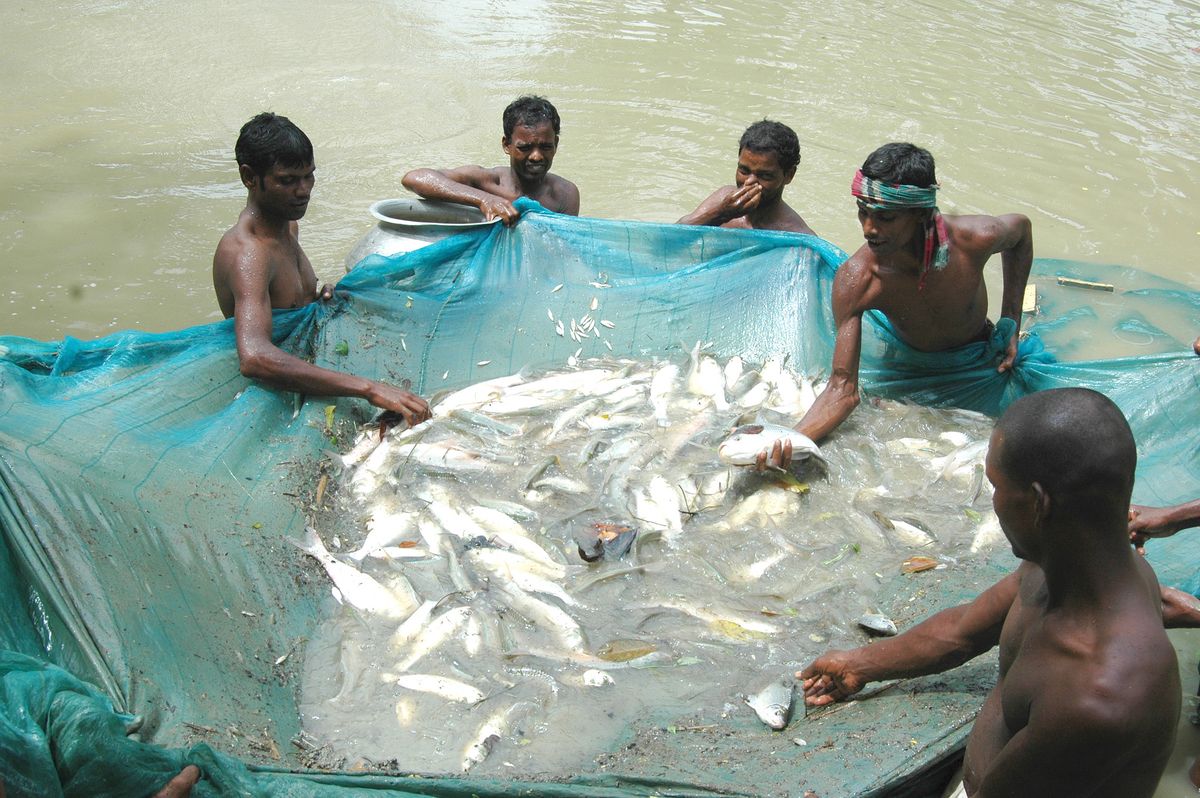
Rajshahi has become particularly well known for producing freshwater carp species such as Rohu, Katla, and Mrigal, alongside Silver Carp and native fish including Pabda, Tangra, Shing, Koi, and Magur. The fish are transported alive using specialised water-filled vehicles equipped with oxygen and water circulation systems, ensuring consumers receive fresh, chemical-free fish.
Among the division’s districts, Natore and Naogaon lead in fish production and marketing, while Paba Upazila in Rajshahi district has become one of the area’s largest fish farming clusters. In Parila Union alone, around 50 truckloads of fresh fish are shipped daily to Dhaka and other districts.
One of the pioneers of the region’s aquaculture success is Gulam Saklain of Durgapur Upazila. He began fish farming in 1994 while studying Chemistry at Rajshahi University, investing just Tk 7,000 in a two-bigha pond. His first production cycle earned a profit of Tk 6,000.
Today, Saklain leases ponds covering around 1,000 bighas, employs 152 people, and sends approximately 20 truckloads of fish to Dhaka every day. He said his decision to pursue fish farming was initially opposed by his family, but the business has grown into a successful commercial enterprise.
Another farmer from Durgapur, Idris Ali, said more than 50 trucks of fish leave the upazila for Dhaka daily. However, he noted that rising feed prices and higher transport costs have reduced profit margins.
“Truck fares to Dhaka have increased by Tk 3,000 to Tk 4,000, while fish prices have not risen accordingly,” he said. Although farmers receive technical advice and training from the Department of Fisheries, he added that financial support remains limited.
Fish farmer Mosharraf Hossain of Parila has been supplying fish to Dhaka and other districts for the past 14 years. He recalled that before improved transport systems were introduced, workers had to manually keep fish alive during the journey by splashing water inside transport vehicles.
“Now water circulation machines keep the fish alive throughout the trip, allowing them to arrive in excellent condition and fetch better prices,” he said. On one recent shipment, he sold 1,200 kg of fish in Dhaka’s New Market for around Tk 300,000.
According to Saifuddin Yahia, Director of the Rajshahi Divisional Fisheries Department, farmers across the division have increasingly adopted mixed-species farming, combining Rohu with Silver Carp, Katla, and native species to improve pond productivity and maintain ecological balance.
He also noted that native species such as Pabda are now regularly exported to India. To support the sector’s continued growth, the Department of Fisheries provides training to more than 1,500 people annually and regularly organises fish fairs and extension programmes for farmers.