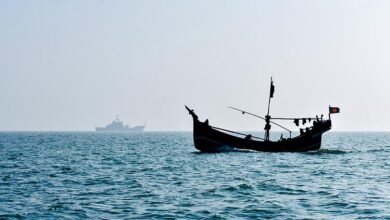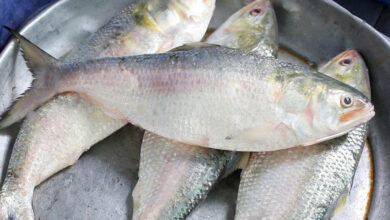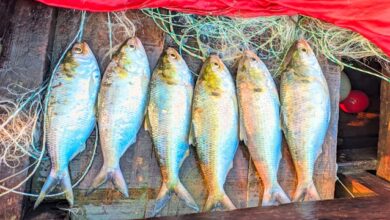
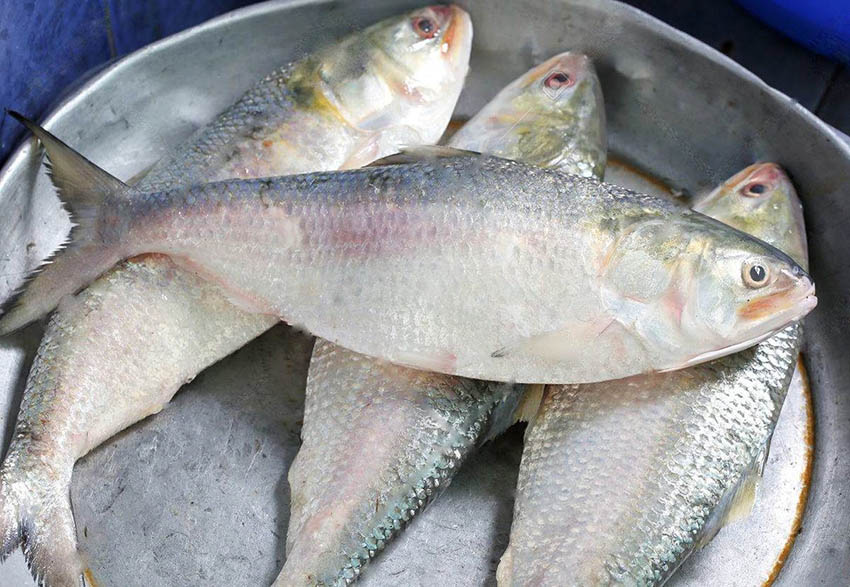
Bangladesh’s hilsa fishers are reporting unusually poor catches during the peak fishing season, raising concerns over the declining production of the country’s most valuable fish and its impact on coastal livelihoods.
Although the Bengali month of Shraban is traditionally one of the busiest periods for hilsa fishing, many fishers operating in the country’s hilsa sanctuaries are returning to shore with little or no catch.
In Bhola, fisherman Sikandar Mia said he caught only two juvenile hilsa while fishing in the Meghna River. Another fisher, Monir Majhi from Shibpur Union, said July was once the most productive month for hilsa fishing.
“Now we return with just one or two small hilsa, if we are lucky,” he said.
Shibpur village, home to around 2,000 fishing families, has seen growing financial hardship as hilsa fishers continue to spend on fuel, ice, and other operating costs without earning enough to cover household expenses or repay loans.
The situation is similar in other coastal fishing areas.
Alauddin Majhi from Mehendiganj said hilsa catches have been declining for the past two to three years.
“This year we have hardly seen any hilsa. Whatever little we catch are small fish. Large hilsa have almost disappeared,” he said.
The declining catch is also affecting fish traders.
Mohammad Kamal, a trader at the Bhola Sadar fish landing station, said he had provided advance payments to fishing boats before the season but is now uncertain whether he will recover his investment due to the poor harvest.
At the wholesale fish market on Port Road in Barishal, traders reported that only 50 maunds (40 kilo makes mound) of juvenile hilsa were available for sale.
According to the Barishal Divisional Fisheries Office, hilsa production has declined steadily over the past three years after reaching a record 372,000 tons in the 2022-23 fiscal year.
Official data show production increased from 258,000 tons in 2015-16 to 372,000 tons in 2022-23, before falling to 348,000 tons in 2023-24, 340,000 tons in 2024-25, and 266,000 tons in 2025-26 – a decline of 70,000 tons compared with the previous year.
The decline is also evident at major fish landing centres. At Alipur Fish Landing Centre in Patuakhali, only one ton of hilsa was landed on Saturday, while total landings for the week reached 2.5 tons, compared with four tonnes during the same period last year.
Md Mohsin, Acting Director of the Barishal Divisional Fisheries Office, said the continued decline highlights the need for scientific research to identify its underlying causes.
He noted that hilsa migrate from the sea to rivers for spawning and suggested that siltation at river estuaries, indiscriminate harvesting of juvenile hilsa, and increasing river pollution may all be contributing to lower production.
However, he stressed that comprehensive scientific studies are needed to confirm the causes. He also said hilsa landings have declined at most of Bangladesh’s 72 fish landing centers.
Mir Mohammad Ali, Assistant Professor at Sher-e-Bangla Agricultural University, said excessive harvesting of brood and juvenile hilsa, weak enforcement of conservation measures, the use of destructive fishing gear, sediment accumulation at estuaries, and insufficient dredging have created poor conditions for hilsa migration and breeding.
He warned that unless these challenges are effectively addressed, hilsa populations may continue to decline, posing a growing threat to Bangladesh’s fisheries sector and the livelihoods that depend on it.