The global seafood industry is approaching a turning point. Wild fisheries have largely reached their biological limits, while the world’s appetite for fish continues to grow every year. Aquaculture already supplies more than half of all seafood consumed globally, and the next chapter of this remarkable growth is expected to unfold not along the shoreline but far beyond it.
Around the world, countries such as Norway, China, Australia and the United States are investing heavily in offshore aquaculture, where fish are cultured in deeper, more energetic marine environments. These offshore production systems are increasingly viewed as the future of sustainable seafood production. For Bangladesh, a nation with a vast maritime territory and an expanding blue economy agenda, offshore aquaculture could become one of the country’s most promising marine industries over the coming decades.
Why the Industry is Looking Offshore
Traditional coastal aquaculture has powered global seafood production for decades. However, many coastal farming areas are now reaching their environmental and spatial limits. Competition with tourism, ports, shipping routes, conservation areas and urban development is intensifying. In many regions, nutrient accumulation, disease outbreaks and declining water quality have become persistent concerns. In this background, offshore farming offers an alternative.
Located several kilometers from the coast in deeper waters, offshore farms benefit from stronger currents, greater water exchange and improved oxygen availability. These natural oceanographic processes disperse organic waste more efficiently, reduce parasite pressure and create healthier growing conditions for cultured fish.
Rather than expanding horizontally along increasingly crowded coastlines, the seafood industry is now exploring the vast production potential of the open sea.
Engineering the Future of Fish Farming
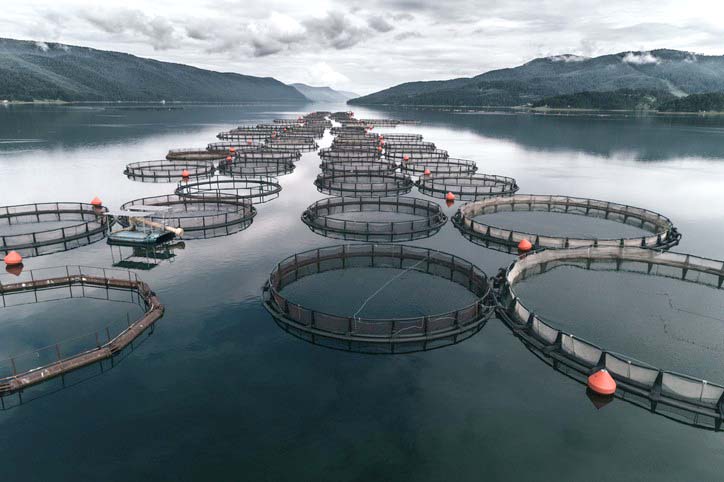
Moving offshore is far more than relocating conventional fish cages into deeper water. It requires an entirely new generation of engineering. Modern offshore aquaculture employs advanced cage systems specifically designed to withstand strong waves, powerful currents and severe weather conditions.
Floating High-density polyethylene (HDPE) cages remain the most widely adopted due to their flexibility and relatively low construction cost. Semi-submersible steel structures can be lowered beneath the sea surface during rough weather, reducing exposure to wave forces. Fully submerged cage systems operate entirely underwater, protecting fish from storms, floating debris and surface disturbances.
Another rapidly developing technology is the closed containment system, where fish are raised inside enclosed tanks or sealed cages. These systems isolate cultured fish from harmful algal blooms, parasites and disease transmission while minimizing waste discharge into the surrounding environment. Although capital-intensive, they represent one of the most environmentally responsible directions for future aquaculture.
These engineering innovations demonstrate that offshore aquaculture is becoming a highly technology-driven industry where structural design, automation and ocean engineering are just as important as fish biology.
Bangladesh’s Untapped Opportunity
Bangladesh possesses one of the largest marine territories in the northern Bay of Bengal following the settlement of maritime boundary disputes. The country’s Exclusive Economic Zone covers more than 118,813 square kilometers, yet marine aquaculture remains remarkably underdeveloped. Most aquaculture production still depends on freshwater ponds and coastal shrimp farming. This imbalance presents a unique opportunity.
With appropriate planning, offshore aquaculture could diversify Bangladesh’s seafood production while reducing pressure on vulnerable coastal ecosystems. Marine finfish with strong commercial value, including cobia, pompano, seabream, groupers and other high-value species, could eventually be cultured in offshore environments for both domestic consumption and export.
Such diversification would strengthen seafood security while opening entirely new value chains within Bangladesh’s marine economy.
Cyclones: Challenge or Design Opportunity?
Whenever offshore aquaculture is discussed in Bangladesh, one concern immediately emerges-cyclones. The Bay of Bengal experiences some of the world’s most destructive tropical cyclones, making structural resilience the defining challenge for offshore farming. However, modern engineering is beginning to address this issue.
Submersible cage technologies allow entire farming systems to descend below the turbulent surface during severe weather, dramatically reducing wave-induced damage. Similar technologies are already being evaluated in cyclone-prone regions around the world.
Rather than treating cyclones as an insurmountable obstacle, Bangladesh can incorporate disaster-resilient engineering into future offshore farm designs from the very beginning.
Offshore Aquaculture as a New Marine Industry
The significance of offshore aquaculture extends far beyond fish production. A successful offshore aquaculture sector would stimulate demand for numerous supporting industries, including: Marine engineering and cage manufacturing, Mooring system production, Vessel construction and maintenance, Automated feeding technologies, Underwater robotics, Environmental monitoring equipment, Remote sensing and GIS services, Hatchery development, Fish feed manufacturing, Cold-chain logistics, Seafood processing and export industries etc.
In many developed countries, offshore aquaculture has evolved into a multidisciplinary industrial ecosystem rather than simply another form of fish farming. Bangladesh has the opportunity to develop similar industrial linkages while creating skilled employment for marine engineers, oceanographers, fisheries scientists, GIS specialists, technicians and coastal entrepreneurs.
Smart Oceans Need Smart Farming
Future offshore farms will not rely solely on manual labour. Artificial intelligence, underwater cameras, autonomous feeding systems, drones, satellite communication, remote sensing and Internet of Things (IoT) technologies are rapidly transforming aquaculture into a data-driven industry.
Real-time monitoring of dissolved oxygen, current velocity, wave height, fish behaviour and feeding efficiency allows operators to optimize production while minimizing environmental impacts. This concept often called Precision Fish Farming is expected to become the operational standard for offshore aquaculture worldwide. Bangladesh’s growing expertise in remote sensing, GIS and marine science places the country in a strong position to embrace these technologies.
The Road Ahead
Despite its enormous promise, offshore aquaculture cannot develop without careful planning. Comprehensive oceanographic surveys, environmental impact assessments, species selection, engineering validation, investment frameworks and supportive government policies will all be essential before commercial production begins.
Pilot-scale demonstration farms should be established to evaluate suitable cage technologies under the unique hydrodynamic conditions of the Bay of Bengal. Collaboration among universities, research institutions, government agencies and private investors will be critical for reducing technical risks and attracting long-term investment.
Offshore aquaculture is more than a new production system. It represents a strategic opportunity to redefine Bangladesh’s seafood industry. As coastal farming areas become increasingly constrained, the open waters of the Bay of Bengal offer space for innovation, technological advancement and sustainable seafood production. By combining modern engineering, scientific research and forward-looking policy, Bangladesh can transform its offshore waters into productive marine assets that generate employment, strengthen seafood exports and support long-term food security. The future of Bangladesh’s seafood industry may not lie closer to shore, it may well begin beyond the horizon.