When we buy fish from the market, we usually check whether its eyes are clear, the gills are bright red, whether it has an unpleasant odor, or if it looks fresh. However, there is one thing that cannot be determined with the naked eye; whether the valuable proteins, omega-3-rich lipids, vitamins, and minerals inside the fish have remained intact. In many cases, a fish may appear perfectly fresh on the outside while much of its nutritional value has already been lost.
In reality, the quality of fish begins to deteriorate immediately after it is harvested. Fish is one of the most highly perishable foods. If it is not chilled with ice immediately or stored at an adequately low temperature, naturally occurring enzymes within the fish become active and begin breaking down proteins. At the same time, healthy lipids undergo oxidation, while vitamins and other essential nutrients gradually decline. In other words, we may be eating fish to obtain its nutritional benefits, but a significant portion of those nutrients may already have been lost before the fish reaches our plate.
This issue is even more critical for marine fish, as they generally lose quality more rapidly than freshwater fish. One of the primary reasons is that marine fish often require several hours or even several days to reach the shore after being caught. If sufficient ice is not used during this period, bacterial load multiplies rapidly and the fish tissues begin to deteriorate. Because fish contain a high proportion of water, microorganisms can proliferate quickly, accelerating spoilage.
compound that helps living fish maintain osmotic balance in the saline marine environment. TMAO is a naturally occurring osmolyte that helps fish regulate the osmotic pressure between their body fluids and the surrounding seawater. However, after the fish dies, bacterial and enzymatic activities convert TMAO into Trimethylamine (TMA), the compound primarily responsible for the characteristic strong “fishy” odour.
Marine fish also contain higher levels of Non-Protein Nitrogen (NPN) compounds than freshwater fish, which serve as readily available nutrients for spoilage bacteria. Furthermore, the valuable omega-3 fatty acids present in marine fish are highly susceptible to oxidative degradation. Consequently, under identical storage conditions, marine fish generally lose quality and spoil more rapidly than freshwater fish.
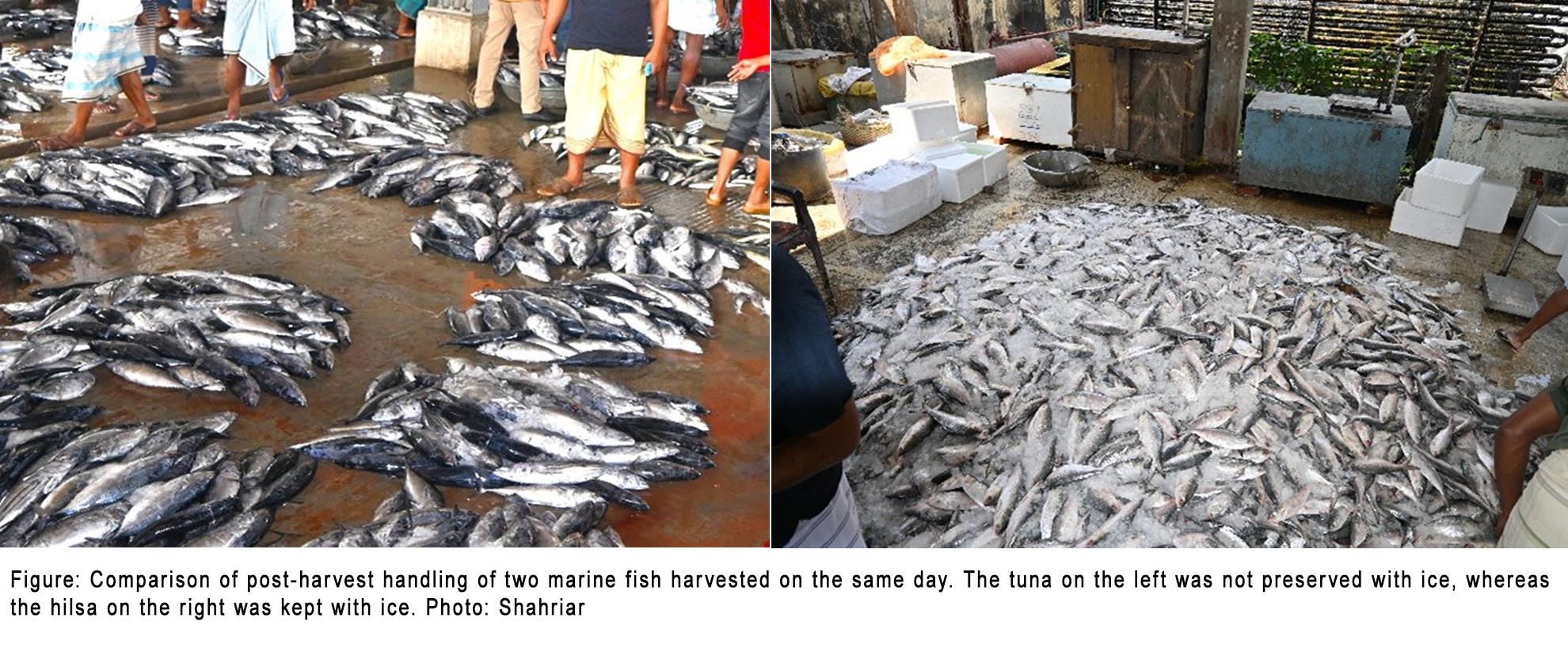
In Bangladesh, an interesting pattern is often observed. Hilsa, due to its high market value, is usually packed in ice immediately after harvest. However, many other marine species including pomfret, seabass, croaker, Bombay duck, tuna, mackerel, and various small pelagic fishes are frequently transported and marketed with little or not sufficient ice for extended periods. Yet these species are more or less equally nutritious. They are excellent sources of high-quality protein, omega-3 fatty acids, calcium, phosphorus, iron, zinc, and many other essential nutrients. Therefore, it is not only hilsa that deserves proper post-harvest care; every marine fish should receive the same level of attention.
Research has shown that due to inadequate handling, preservation, and marketing practices, approximately 10–15% of the fish harvested in Bangladesh loses quality or undergoes partial spoilage at different stages of the supply chain. This results in economic losses amounting to thousands of crores of taka every year. More importantly, consumers are often eating fish whose nutritional quality has already declined considerably. The biological quality of fish protein decreases, lipids become oxidized, and certain vitamins may also be reduced. As a result, consumers fail to obtain the full nutritional benefits of fish.
One study reported that, on average, 72.3 kg of physical loss occurs for every 1,000 kg of marine fish harvested, meaning that approximately 7.23% of the catch becomes damaged, spoiled, or unsuitable for marketing and consumption. These losses are not limited to fish becoming completely spoiled. They also include reductions in product quality, nutritional value, and market price. Therefore, we are not merely losing fish, we are losing valuable nutrients, the fair income of fishers, and an important national resource.
Developed overseas countries recognized this challenge many years ago. Consequently, fish are chilled immediately after harvest and the cold chain is maintained throughout transportation and marketing. A widely adopted principle in the seafood industry is: “Catch cold, keep cold.” In other words, fish should be chilled immediately after capture, and a consistently low temperature must be maintained throughout the entire supply chain. Once fish quality begins to deteriorate after harvest, it cannot be restored; it can only be preserved through proper cold storage. Bangladesh has made remarkable progress in the fisheries sector, reaching a record 5.111 million metric tonnes (5.1.11 lakh MT) of total fish production in FY 2024–25. This achievement reflects the country’s continued commitment to fisheries and aquaculture development and its vital role in ensuring food and nutritional security, supporting livelihoods, and contributing to the national economy.
However, increasing production alone is not enough. Unless fish are handled, preserved, transported, and marketed properly after harvest, a significant portion of their nutritional value, quality, and economic value can be lost before they reach consumers.
For Bangladesh, the time has come to prioritize not only increasing fish production but also preserving fish quality. The true value of a fish lies not merely in its weight, but in its nutritional quality. If fish can be transported and marketed while still alive whenever feasible, and if those that die are immediately preserved with sufficient ice and appropriate refrigeration, post-harvest losses can be significantly reduced. Consumers will receive safer, fresher, and more nutritious fish; fishers will obtain fairer prices for their hard work; post-harvest food waste will decline substantially; and Bangladesh’s Blue Economy will become stronger and more sustainable.
As a fundamental principle of post-harvest fish quality management, we must remember:
“Fish quality cannot be improved after harvest; it can only be maintained through proper handling, sufficient icing, and appropriate refrigeration.”
Al Shahriar
Fisheries Management Officer
Nature Conservation Management (NACOM)
Cox`s Bazar, Bangladesh