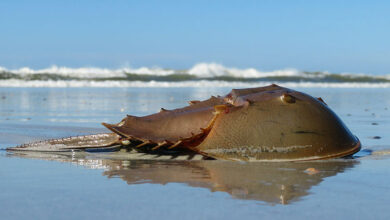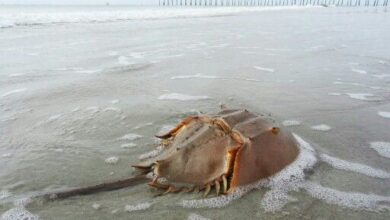
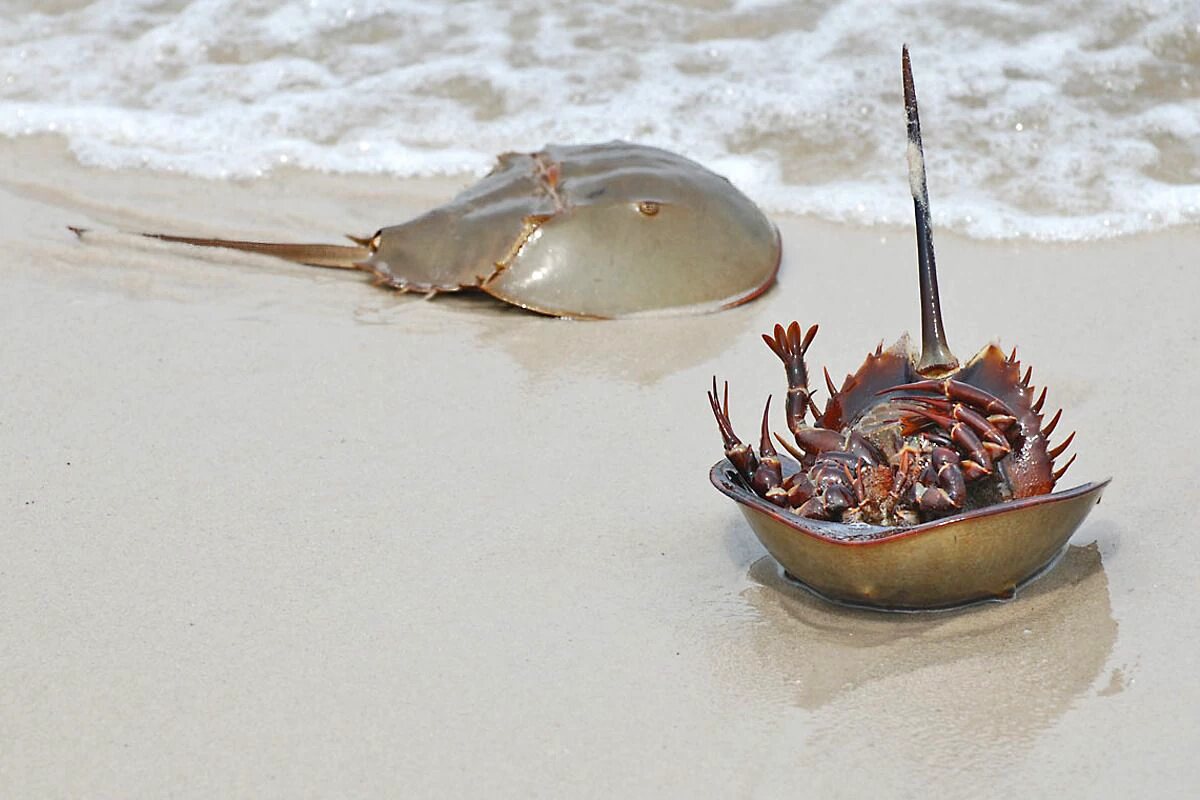
For more than 450 million years, horseshoe crabs have survived mass extinctions, shifting continents, and dramatic climate changes that wiped out countless species including the dinosaurs. Often called “living fossils,” these ancient marine arthropods are among Earth’s oldest surviving animals. Yet their greatest contribution may not lie in their extraordinary evolutionary history, but in their remarkable blue blood, which has become indispensable to modern medicine.
The blue blood of horseshoe crabs contains Limulus Amebocyte Lysate (LAL), a substance used worldwide to detect bacterial endotoxins in vaccines, injectable medicines, surgical implants, and other medical devices. Before these products reach hospitals and patients, LAL helps ensure they are free from harmful bacterial contamination, making horseshoe crabs silent contributors to global public health.
Bangladesh, with its rich coastal ecosystems, is home to two species of horseshoe crabs the Indo-Pacific horseshoe crab (Tachypleus gigas) and the mangrove horseshoe crab (Carcinoscorpius rotundicauda). Despite their ecological and biomedical importance, these species remain among the country’s least understood marine animals.
At Chattogram Veterinary and Animal Sciences University (CVASU), Prof. Dr. Sk. Ahmad Al Nahid, Professor and Head of the Department of Fisheries Resource Management, is working to change that. Through years of research on horseshoe crab biology, conservation, blood physiology, and captive culture, his team is laying the scientific foundation for what could become one of Bangladesh’s most promising marine conservation initiatives.
A Research Journey Inspired by Curiosity and Conservation
For Dr. Al Nahid, the journey began with a simple realization. Having spent much of his academic career in conservation biology, he was intrigued to discover that one of the world’s oldest surviving marine animals still inhabits Bangladesh’s coastline. Learning that horseshoe crab blood plays a crucial role in pharmaceutical safety only strengthened his determination to study the species.
That curiosity gradually evolved into a long-term research programme involving undergraduate and postgraduate students. Today, his laboratory investigates horseshoe crab conservation, biology, blood characteristics, and captive rearing research that is steadily placing Bangladesh on the global horseshoe crab research map.
An Ancient Species Facing Modern Threats
Although both horseshoe crab species found in Bangladesh are currently classified as Data Deficient by the IUCN, available national studies suggest that their populations are already under significant pressure.
The mangrove horseshoe crab depends on muddy mangrove habitats in Cox’s Bazar and the Sundarbans for spawning before adults migrate offshore into Bangladesh’s Exclusive Economic Zone (EEZ). The Indo-Pacific horseshoe crab is encountered mainly in offshore fishing grounds, where both species frequently become accidental bycatch.
Their survival is increasingly threatened by the degradation of mangrove habitats, accidental capture in fishing gear, coastal pollution, barnacle infestation, rising temperatures, and other climate-related stresses. “These pressures are working simultaneously,” Dr. Al Nahid explains, making conservation more urgent than ever.
Can Horseshoe Crabs Be Cultured?
Unlike shrimp or finfish, horseshoe crabs are not being cultured for food production. Instead, international research focuses primarily on biomedical applications and species conservation.
At CVASU, Dr. Al Nahid’s research team has already succeeded in maintaining horseshoe crabs under captive conditions to determine whether captivity alters their blood haematology, an important consideration for biomedical research. Their findings have already been published in peer-reviewed journals, while additional manuscripts are currently under review.
They hope to artificially breed horseshoe crabs, rear juveniles under controlled conditions, and eventually release them back into the sea through sea ranching, strengthening wild populations while advancing conservation science.
Why Culture Remains a Scientific Challenge
Culturing horseshoe crabs is far more demanding than farming conventional aquaculture species. A juvenile horseshoe crab requires approximately 12 to 13 years to reach adulthood, making long-term captive culture both technically difficult and financially demanding.
For this reason, conservation programmes around the world generally focus on raising juveniles until they become strong enough for release rather than maintaining them throughout their entire life cycle. Dr. Al Nahid believes this approach offers the most practical pathway for Bangladesh as well.
Small Creatures, Big Ecological Value
Although often overlooked, horseshoe crabs play an essential role in maintaining healthy coastal ecosystems. Their eggs provide food for migratory shorebirds and numerous other coastal animals. Their burrowing behavior naturally aerates and mixes sediments, helping maintain productive mudflats and mangrove ecosystems. Because they respond quickly to environmental change, scientists also consider them valuable indicators of ecosystem health. Yet their greatest economic significance lies in biotechnology.
The amoebocyte lysate extracted from horseshoe crab blood remains one of the world’s most important tools for detecting bacterial toxins in vaccines, injectable medicines, and medical devices. This makes horseshoe crabs a unique intersection between marine biodiversity and modern healthcare.
Could Bangladesh Join the Global Biomedical Supply Chain?
Countries such as the United States, China, and Japan have invested decades in horseshoe crab research. Bangladesh is only beginning that journey.
According to Dr. Al Nahid, realizing this potential will require sustained scientific investment. Researchers must first determine whether lysate produced from Bangladesh’s horseshoe crab species performs as effectively as existing international products while ensuring that animals remain healthy following non-lethal blood collection. Only after answering these scientific questions can Bangladesh realistically explore opportunities within the global biomedical industry.
What Needs to Happen Next?
Dr. Al Nahid believes Bangladesh must move beyond isolated research projects and adopt a comprehensive national strategy for horseshoe crab conservation.
He recommends providing explicit legal protection for the species, safeguarding spawning habitats in Cox’s Bazar and the Sundarbans, engaging fishing communities in safe release practices, and ensuring long-term funding for population monitoring, habitat mapping, artificial breeding, sea ranching, and biomedical research.
Equally important, he emphasizes building modern laboratory facilities, developing skilled researchers, and strengthening international scientific collaboration.
Protecting the Past to Shape the Future
For young scientists, horseshoe crab research demands patience, interdisciplinary thinking, and long-term commitment. Understanding these remarkable animals requires integrating ecology, physiology, genetics, biotechnology, and marine conservation.
For policymakers, however, Dr. Al Nahid’s message is even more urgent: conservation must begin before a species reaches the brink of extinction.
Protecting Bangladesh’s mangrove spawning grounds today will require relatively modest investment. Waiting until horseshoe crabs disappear, he warns, could make recovery impossible.
As the world searches for sustainable solutions that unite biodiversity conservation, biotechnology, and the Blue Economy, Bangladesh has an opportunity hidden beneath its coastal waters. The horseshoe crab, an animal that has survived for 450 million years, may yet help shape the country’s scientific future. Through the pioneering work of researchers like Prof. Dr. Sk. Ahmad Al Nahid, Bangladesh is taking its first meaningful steps toward ensuring that this ancient survivor continues to thrive for generations to come.
Md. Shofiullah
Student, Department of Oceanography
Noakhali Science and Technology University