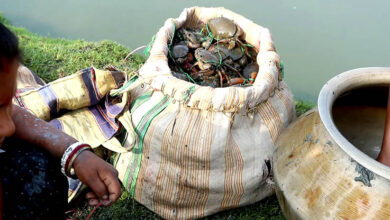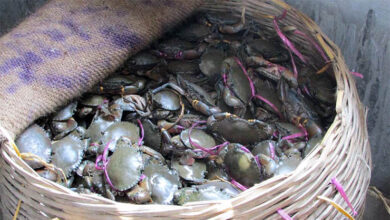
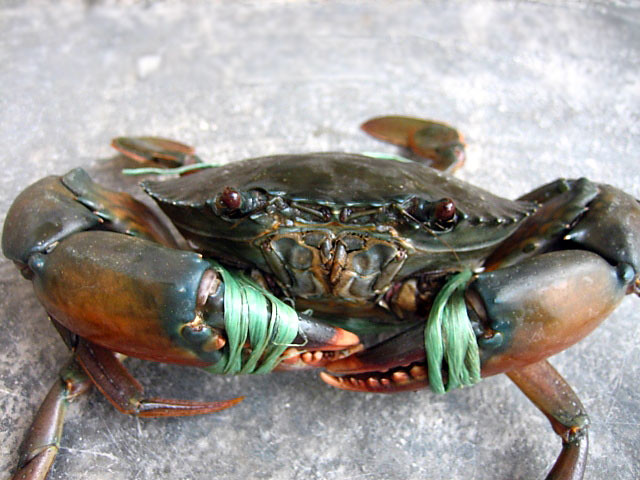
Once known primarily for rice cultivation and freshwater fish/prawn farming, Dumuria upazila in Khulna is rapidly establishing itself as one of Bangladesh’s emerging centers for commercial crab farming. Driven by strong export demand, favourable natural conditions, and attractive returns, crab farming has become a profitable livelihood for thousands of rural families and is adding a new dimension to the coastal economy.
Across several unions of the upazila, farmers are increasingly replacing traditional crops with crab fattening, attracted by lower production risks, comparatively modest investment requirements, and a production cycle of just three to four months. The sector is now generating employment, strengthening household incomes, and contributing to Bangladesh’s seafood exports.
Across Dumuria, commercial crab farming has expanded rapidly, particularly in the unions of Dhamalia, Raghunathpur, and Magurghona, where crab fattening has become a widely adopted livelihood. Crab cultivation is also practiced in ponds and beels (wetlands) across Khornia, Bhandarpara, Rupadanga, Shovna, and Gutudia unions, reflecting the steady expansion of the sector throughout the upazila.
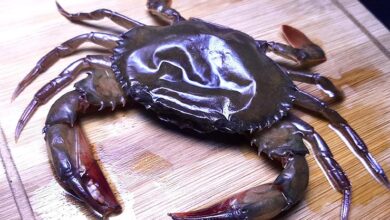
Local farmers say crab farming has gained popularity because it offers better returns than paddy cultivation and conventional fish farming. Both soft-shell and hard-shell crab fattening are widely practiced, supplying domestic markets as well as international buyers.
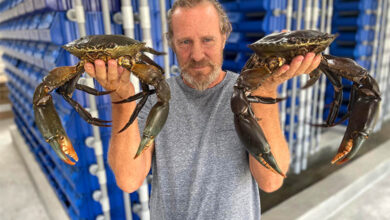
Bangladesh is home to 15 crab species, including 11 marine species and four freshwater species. Among them, the red crab is the country’s largest and most commercially valuable species.
During visits to villages across Dumuria, farmers said the area’s transition towards crab farming accelerated after Cyclone Aila. Before the cyclone, most agricultural land produced only a single rice crop each year. As salinity increased in the aftermath of the disaster, many farmers converted former crop fields into ponds suitable for crab cultivation.
Today, more than 5,000 farmers, including a significant number of women, have become financially self-reliant through crab farming in Dumuria. Once recognised as the “kingdom of agriculture and fish” in Bangladesh’s coastal belt, the upazila is now emerging as an important hub for commercial crab production.
According to the Department of Fisheries (DoF), nearly 28,000 farmers, including around 9,000 women, across Khulna Division have become self-reliant through training, technical assistance, and market support provided by the department.
Dumuria Senior Fisheries Officer Sohel Md. Zillur Rahman Rigan said the area’s saline soil and water create ideal conditions for crab farming.
“The Department of Fisheries is providing regular technical support, guidance on quality seed selection, and farm management practices. Because crab farming involves lower risks and higher profitability, more entrepreneurs are entering the sector, making a significant contribution to the local economy,” he said.
Khulna District Fisheries Officer Md. Badruzzaman said crabs produced in the region are exported to several international markets, including China, Singapore, Malaysia, Hong Kong, Thailand, South Korea, Taiwan, Australia, Japan, and the United Arab Emirates.
He said the government is working to improve market access, reduce dependence on intermediaries, ensure fair prices for farmers, and promote environmentally sustainable crab farming practices.
For many farmers, crab farming has become more than just a business, it has transformed their lives.
Ashutosh Ghosh, a farmer from Tipna village, said he shifted to crab farming because it provides higher returns than either fish or rice cultivation. The 35-year-old now spends most of his day managing his crab ponds to support his family.
Another farmer, Monali Saha, said crab farming has been the primary source of income for her family for the past five years.
“My husband and I farm crabs on one acre of land,” she said. “However, middlemen still earn more than we do because we cannot sell directly to buyers.”
Farmers Salman Sheikh, Swapan Mondal, and Rishikesh Das, from different unions of Dumuria, said many families that once struggled with debt have achieved financial stability through crab farming. Some have built permanent homes, while others have purchased agricultural land with their earnings.
However, they believe the sector still has significant room for growth. Farmers called for easier access to institutional credit and greater investment in crab hatcheries to support artificial seed production. They said such measures would reduce dependence on wild seed and help position crab farming as another major seafood export industry alongside Bangladesh’s shrimp sector.