Thailand’s shrimp industry remains under pressure from long-term production challenges, even as a recent trade dispute with Malaysia appears to be moving towards a resolution.
Malaysia suspended imports of Thai shrimp on 1 June, making the sector a key concern for the Thai government. Although talks between the two countries in early July have raised hopes that the ban may soon be lifted, industry leaders say the bigger challenge is rebuilding an industry that has struggled for more than a decade.
Shrimp production remains far below its peak
According to Ekapoj Yodpinit, President of the Thai Shrimp Association, Thailand was once the world’s largest shrimp producer and exporter.
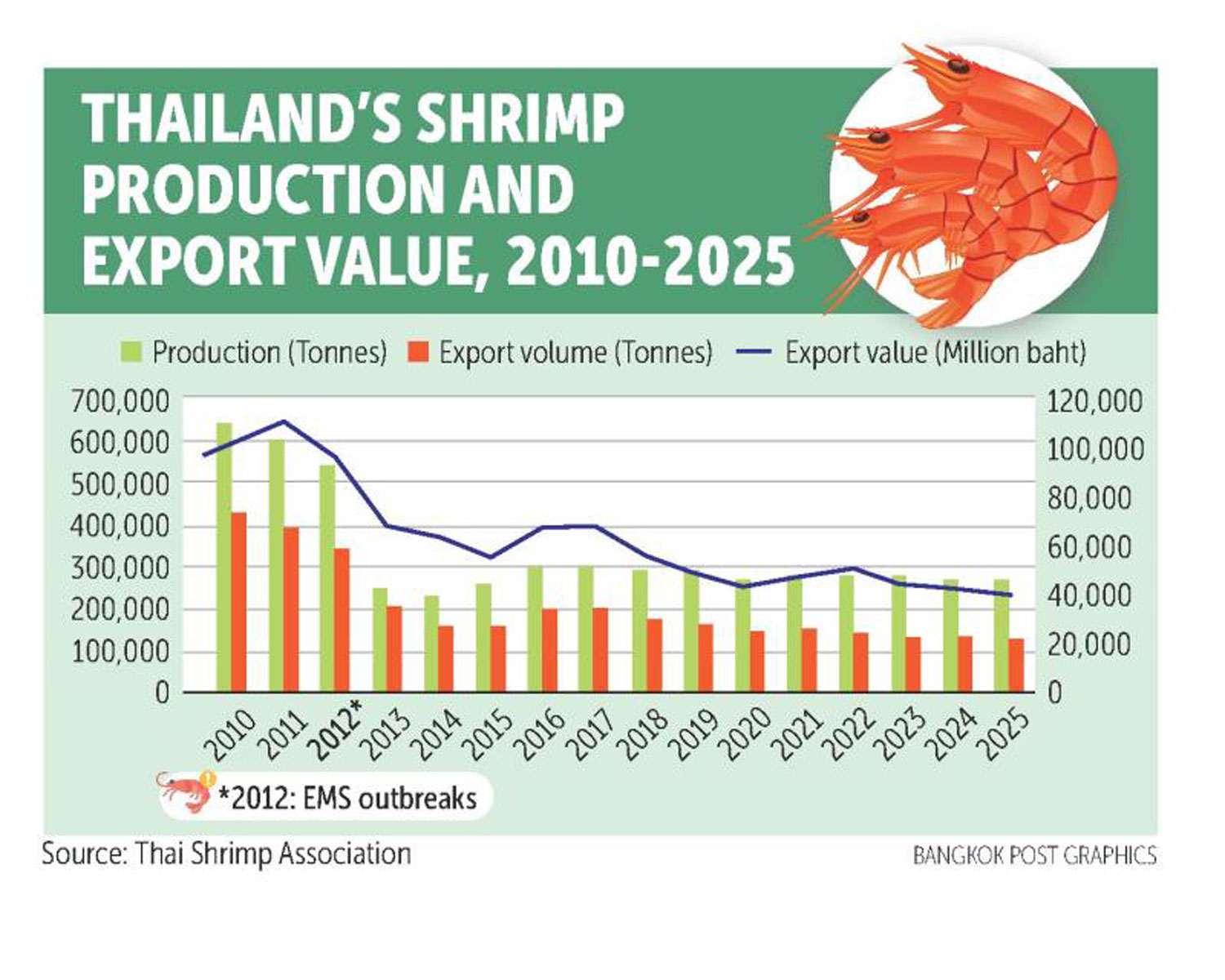
At its peak in 2010, the country produced around 640,000 tonnes of shrimp annually, with exports valued at more than 110 billion baht.
However, the outbreak of Early Mortality Syndrome (EMS) in 2012 severely affected the industry. Since then, annual shrimp production has fallen to around 270,000–280,000 tonnes, while export earnings have declined to about 40 billion baht a year.
In 2025, nearly 48% of Thailand’s shrimp production was exported, with the remaining volume consumed in the domestic market.
The industry has set a production target of 400,000 tonnes for this year. If achieved, shrimp exports could exceed 250,000 tonnes.
Why Malaysia suspended Thai shrimp imports
The import suspension was triggered by trade measures and Malaysia’s stricter food safety requirements.
In May, Thailand restricted imports of Malaysian sea bass over concerns about chemical residues. In response, Malaysia temporarily banned imports of Thai shrimp, citing food safety regulations.
The restriction covers five shrimp species: whiteleg shrimp (Litopenaeus vannamei), black tiger shrimp, tiger prawn, banana shrimp, and blue shrimp.
Malaysian authorities have said the suspension will remain until Thailand’s agricultural authorities submit the required food safety documentation for review.
Limited export share but wider market impact
According to Kasikorn Research Center (K-Research), Malaysia is Thailand’s 11th-largest market for shrimp exports, accounting for around 1% of the country’s total shrimp exports.
Fresh, chilled, and frozen shrimp make up 97% of exports to Malaysia, while processed products, including canned shrimp, account for the remaining 3%.
Before the ban, Thailand exported around 100 tonnes of shrimp to Malaysia every day, equivalent to about 3,000 tonnes per month, according to Ekapoj.
Although Malaysia represents only a small share of Thailand’s export market, K-Research said the suspension has added further pressure to an industry already facing weaker international demand and intense competition in global markets.
Farm-gate prices fall
The suspension has forced exporters to redirect shrimp originally destined for Malaysia to other markets, increasing pressure on domestic prices.
Ekapoj said farm-gate shrimp prices fell by 50–60 baht per kilogramme after the ban came into effect. Prices have since recovered by 20–30 baht per kg as shrimp supply declined following the harvest season in southern Thailand.
However, retail shrimp prices have not fallen as sharply because transport and other marketing costs continue to keep consumer prices relatively high.
Industry leaders believe that while resolving the trade dispute with Malaysia would provide short-term relief, restoring Thailand’s shrimp production and export competitiveness will require addressing the structural challenges that have affected the sector since the EMS outbreak more than a decade ago.