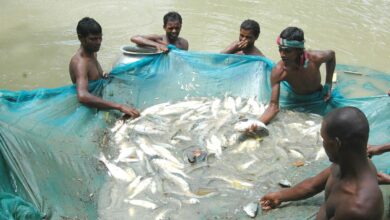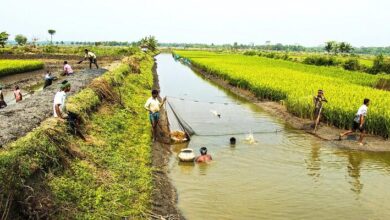
Bangladesh is emerging as a global leader in aquaculture, accounting for nearly 59% of the country’s total fish production. Beyond feeding millions, this sector is quietly advancing the United Nations Sustainable Development Goals (SDGs), demonstrating how strategic aquaculture can simultaneously address food security, health, and economic development.
Small Indigenous Species (SIS), such as Mola and Dhela, supply essential micro-nutrients, strengthening nutrition and reducing malnutrition (SDG 2 and SDG 3). At the same time, income generated from rural aquaculture improves access to clean water and sanitation (SDG 6), creates employment across production and processing (SDG 8), and reduces poverty and inequality (SDG 1 and SDG 10). Innovative farming systems, including rice-fish and integrated fish-vegetable ponds, support climate action (SDG 13) while conserving aquatic biodiversity (SDG 14) and promoting responsible consumption (SDG 12).
From stabilizing urban fish supplies through rooftop and peri-urban aquaponics (SDG 11) to fostering partnerships among government, private enterprises, and research institutions (SDG 16 and SDG 17), Bangladesh’s aquaculture sector illustrates the potential of a climate-adapted, sustainable, and socially inclusive food system. This story is not just about production; it reflects how a deltaic nation is transforming environmental and socioeconomic challenges into opportunity, offering a blueprint for the Global South on the path toward the 2030 SDGs.
The Economic Anchor: From Ponds to Prosperity
Bangladesh’s aquaculture transformation is remarkable. By 2026, the sector contributes over 3.5% to national GDP and roughly 25.7% to agricultural GDP, supporting the livelihoods of nearly 19 million people, or about 12% of the population.
The country is also moving beyond raw exports toward value-added production. Modern processing facilities in Khulna and Chattogram now comply with stringent EU and US traceability, HACCP standards, allowing Bangladesh to compete in premium international seafood markets.
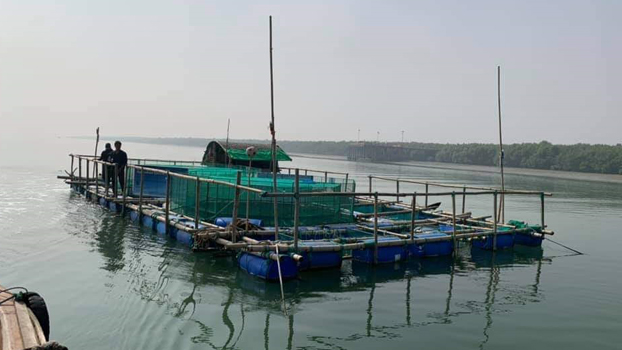
Innovations such as Integrated Multi-Trophic Aquaculture (IMTA), cultivating shrimp alongside seaweed and mussels, are diversifying income streams while reducing ecological pressure, lowering the risks associated with monoculture dependency.
The “Nature’s Multivitamin” Strategy
While exports fuel economic growth, nutrition remains at the heart of Bangladesh’s aquaculture strategy. Mola and Dhela are exceptionally rich in Vitamin A, iron, zinc, and essential fatty acids, making them critical in combating micro-nutrient deficiencies that remain widespread in rural communities. Unlike larger commercial species, SIS are often consumed whole head, bones, and organs maximizing their nutritional impact, particularly for women and children.
Through carp-SIS polyculture systems, farmers are not only increasing productivity but also reshaping household nutrition. Larger carp generate income in the market, while SIS are retained for family consumption, creating a built-in mechanism for both income security and dietary diversity. This integrated approach directly supports SDG 2 (Zero Hunger) and SDG 3 (Good Health and Well-being), with growing evidence linking it to reductions in childhood stunting and hidden hunger in aquaculture-dependent communities.
More than a farming technique, this model represents a paradigm shift in which aquaculture is no longer viewed solely as a source of revenue, but as a public health intervention embedded within food systems. In doing so, Bangladesh is positioning itself at the forefront of nutrition-sensitive aquaculture, offering a scalable and replicable solution for other developing nations facing similar challenges.
Innovation Under Pressure: The Tech-Driven Delta
Climate stress has become a catalyst for innovation across Bangladesh’s aquaculture landscape, driving a shift from traditional practices to data-driven and climate-adaptive systems.
In key production hubs such as Mymensingh and Jessore, “Smart Pond” technologies are redefining farm management. IoT-enabled sensors continuously track critical water quality parameters such as dissolved oxygen, pH, and temperature are translating real-time data into actionable insights delivered directly to farmers’ mobile devices. This precision-based approach not only optimizes feeding and reduces input costs but also minimizes the risk of sudden mass mortality events, a major source of financial loss in aquaculture.
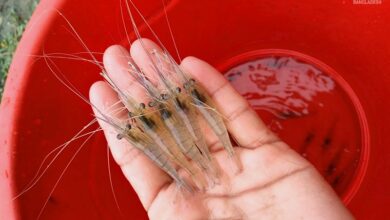
At the same time, Bangladesh’s salinity-affected coastal belt is undergoing a strategic transformation. Through salt-tolerant aquaculture, farmers are diversifying into high-value species such as Artemia (brine shrimp), mud crab, and brackish-water finfish like sea bass (Koral). This shift reflects a broader transition from vulnerability to climate-smart resource utilization, where saline intrusion is no longer a constraint but a productive asset.
Rather than resisting environmental change, Bangladesh is learning to work with it, leveraging technology and ecological adaptation to convert climate pressure into economic opportunity. In doing so, the country is setting a precedent for how aquaculture systems in climate-vulnerable regions can evolve to remain both resilient and profitable.
The Social Fabric: Inclusion Beneath the Surface
Sustainability in Bangladesh’s aquaculture sector is not only ecological or economic; it is fundamentally social. The long-term success of the Blue Revolution is increasingly tied to how equitably its benefits are distributed across communities.
Women are emerging as key actors within the aquaculture value chain, particularly in feed management, hatchery operations, and post-harvest processing. Their participation is not merely supportive; it is reshaping household economies by increasing income stability, improving nutrition, and strengthening decision-making roles within families.
At the same time, Community-Based Aquaculture (CBA) models are opening new pathways for inclusion. By granting landless and marginalized groups access to government-owned water bodies (Khas lands), these initiatives are transforming common resources into shared economic assets. This approach not only creates livelihoods but also fosters local stewardship, accountability, and collective management of aquatic resources.
Together, these inclusive practices ensure that the gains of aquaculture extend beyond commercial producers, embedding resilience at the community level. In this sense, Bangladesh’s aquaculture model is not only productive but also demonstrates how social equity can be integrated into the foundation of sustainable blue growth.
Challenges on the Horizon
Despite its rapid growth, Bangladesh’s aquaculture sector faces a set of interconnected challenges as it moves toward its ambitious 2031 production target of 8.5 million metric tons. Addressing these constraints will be critical for sustaining long-term growth and global competitiveness.
- Feed Sustainability and Cost Pressure
The sector remains heavily dependent on imported fishmeal and fish oil, exposing farmers to global price volatility and supply disruptions. Developing alternative protein sources such as insect-based feed, algae, and agricultural by-products is essential to reduce costs and improve environmental sustainability.
- Climate Volatility and Environmental Stress
Rising temperatures, erratic rainfall, salinity intrusion, and increasingly frequent cyclones continue to threaten production systems. Strengthening climate-resilient infrastructure is crucial to minimize losses and ensure continuity.
- Traceability and Market Compliance
As export markets tighten regulations, particularly in the EU and US, ensuring end-to-end traceability has become a necessity. However, integrating smallholder farmers into digital tracking systems remains a challenge, requiring investment in technology, training, and standardized protocols.
- Disease Management and Biosecurity
Disease outbreaks, especially in shrimp farming, pose a persistent risk to productivity and export stability. Weak biosecurity practices and limited diagnostic capacity can lead to large-scale losses. Strengthening early warning systems, hatchery standards, and farm-level biosecurity is essential.
- Access to Finance and Technology
Small-scale farmers often lack access to affordable credit, insurance, and modern technologies. This limits their ability to adopt innovations such as smart aquaculture systems, quality feed, and improved seed. Expanding financial inclusion and extension services is key to scaling sustainable practices.
- Governance and Institutional Coordination
Fragmented policies, regulatory gaps, and limited coordination among stakeholders can slow progress. Strengthening governance frameworks, public-private partnerships, and research-extension linkages will be critical to ensure coherent sectoral development.
Aquaculture sets Bangladesh apart through its ability to align economic growth with social and environmental priorities. From improving rural livelihoods and nutrition through Small Indigenous Species (SIS) to advancing climate-smart practices and inclusive governance, the sector has evolved into a multi-dimensional development engine. Its experience demonstrates that even under intense climate pressure, vulnerability can be transformed into opportunity through innovation, policy support, and community engagement.
As the world moves closer to the 2030 Sustainable Development Goals (SDGs), the lessons emerging from Bangladesh’s delta are clear: the future of aquaculture lies not only in increasing production, but in building systems that are resilient, equitable, and environmentally sound. In this regard, Bangladesh offers a compelling blueprint for the Global South, where water is being reimagined as a foundation for sustainable growth and shared prosperity.
Md. Shofiullah
Student, Department of Oceanography
Noakhali Science and Technology University