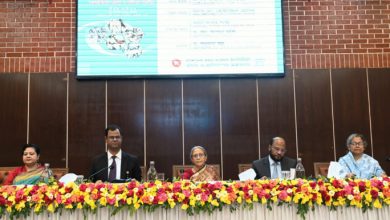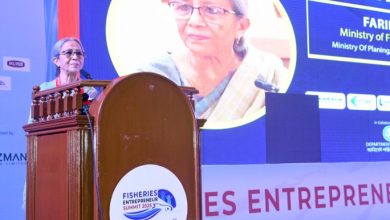
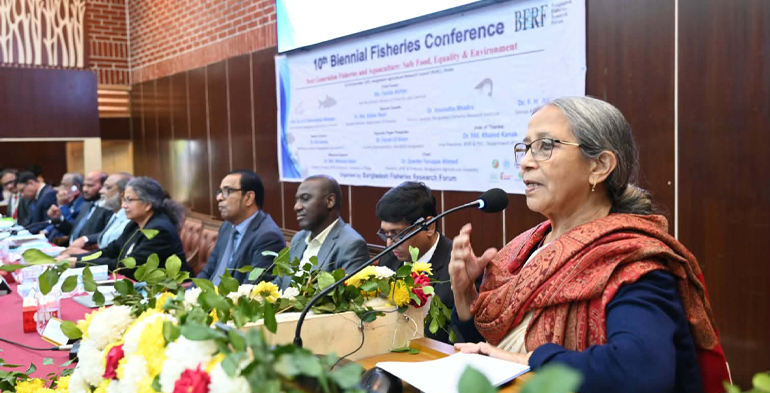
Fisheries and Livestock Adviser Farida Akhter said that although fish supply in the country has increased due to the expansion of agriculture-based production, it has also created new challenges. One of the biggest challenges is food safety. She said that there is no point in increasing fish production if food safety is not ensured. If fish produced through aquaculture is not safe, it cannot truly be called fish. This is something everyone must keep in mind.
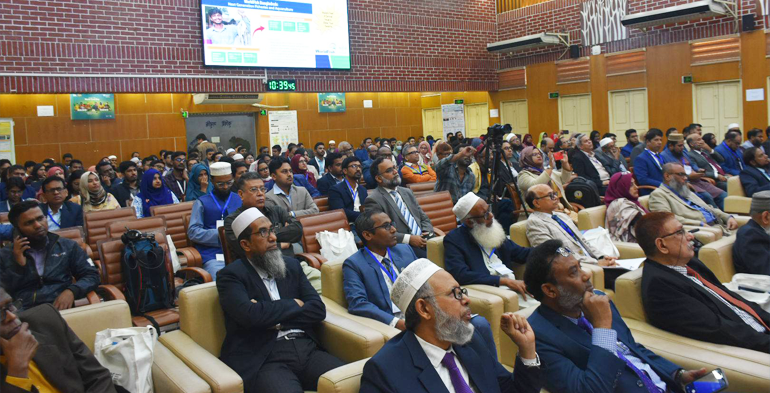
She made these remarks this morning while speaking as the chief guest at the opening session of the 10th Biennial Fisheries Conference, organised by the Bangladesh Fisheries Research Forum (BFRF) at the Bangladesh Agricultural Research Council (BARC) auditorium.
The adviser said that fish is not just food to fill the stomach; it is a very important source of nutrition. Fish provides essential micronutrients, calcium, and other nutrients that help in the development of eyesight, bones, and intelligence. She added that fish-based food habits have played a major role in the intellectual development of the Bengali people.
Speaking about marine fisheries resources, she said Bangladesh has not yet fully used its potential. At present, only about 30 percent of these resources are being used, and even within this limited use, there are many problems. She explained that artisanal trawlers and industrial trawlers follow different fishing methods, and some technologies used by industrial trawlers have created new concerns. She said that going to sea seven times and catching fish only once is not acceptable, just as it is not right to use SONAR (Sound Navigation and Ranging) technology to catch all fish in a single trip.
The fisheries adviser said that it has recently been found that around 70 out of 223 industrial trawlers are using SONAR technology, which has increased the risk of overfishing in the sea. To address these problems, effective policies are urgently needed. She said the government has taken an important step by deciding to update the National Fisheries Policy. Some reforms have already been made to the Fisheries Act, but more changes are needed, which she wants to implement during her tenure. She expressed serious concern about harmful fishing gear, saying that old fishing gear is now being modified in ways that damage the environment and biodiversity. In some cases, fish are even being caught using electric shocks, which is completely unacceptable.
She also said there is discrimination in providing incentives to fishers. Compared to the support given to the agriculture sector, fishers do not receive fair incentives. During fishing ban periods, fishers often do not get the assistance they need, which sometimes forces them to break the rules unwillingly.
The adviser said that hilsa breeding and migration are being severely disrupted due to reduced river depth, pollution, and the combined effects of climate change. She stressed that hilsa is not just a fish but a national asset. Just like dolphin conservation, hilsa protection should be part of a global movement. She added that obstacles in hilsa migration routes have been identified, and requests have been made to the Bangladesh Inland Water Transport Authority (BIWTA) to carry out necessary dredging in coordination with relevant agencies.
At the conference, the keynote paper was presented by Dr Faruk-ul Islam, Country Representative of WorldFish Bangladesh. FAO Representative in Bangladesh (ad-interim) Dr Dia Sanou spoke as an honoured guest. Special guests included Director General of the Department of Fisheries Dr Md Abdur Rouf, Director General of the Bangladesh Fisheries Research Institute Dr Anuradha Bhadra, and Group Adviser of ACI PLC Dr F. H. Ansari.
The session was chaired by BFRF President Dr Joarder Faruk Ahmed. The welcome speech was delivered by Secretary General Dr Md Monirul Islam, and the vote of thanks was given by Vice President Dr Md Khaled Kanak.