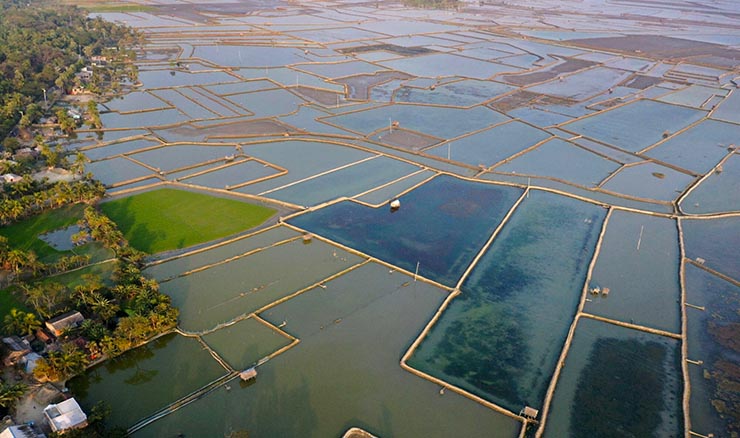
The United Nations projected world population to reach 9.8 billion people by 2050, with certainty confidence of 95 percent that world population size will be between 9.4 to 10.1 billion in 2050. Urbanization will continue to accelerate and about 70 percent of the global population will be urban compared to 49 percent of present day. This enormous number of populations will consume more food, energy and need more living space. To deal with these overbearing issues, United Nations introduced the concept of Sustainable Development Goals (SDGs). With different objectives and areas of focus of SDGs, SDG-02 (ZERO HUNGER) prioritizes to end hunger, improve food security and promote sustainable agriculture. In this regard, aquaculture can play a significant role to increase food production ensuring food security.
The study, practice, and business of cultivating aquatic organisms-such as fish, shellfish, crustaceans, and aquatic plants-in controlled environments for food, ecological and commercial purposes is referred to as aquaculture. It entails regulating water quality, nutrition, breeding, disease management, and habitat conditions to guarantee healthy development and sustained output. With distinct environmental conditions, aquatic organisms can be cultivated in marine, estuarine or freshwater environment.
Mariculture (aquaculture in marine environment) play exceptionally robust role driven by massive transition from wild seafood harvesting to controlled sea farming. As it fosters economic growth, employment, and food security, it has risen in relevance as a part of the global blue economy. Several reports show that cultured aquatic production covers for half of all human seafood consumption. Related projections suggest that it will dominate 56 percent of total global fisheries by 2034. The growing demand for premium seafood items has propelled the growth of mariculture. Shrimp farming holds a prominent position in this industry because of its high market value, rapid production cycle, and substantial contribution to global commerce and food security.
Shrimp farming is the process of breeding, rearing and harvesting of shrimp in controlled aquatic systems for food production and commercial sale. Pursuant to the OECD-FAO Agricultural Outlook 2025-2034, shrimp and prawn aquaculture yield is anticipated to increase by approximately 38 percent over the next ten years, outpacing the growth of the majority of other farmed aquatic species. The worldwide shrimp industry is expected to grow from its anticipated USD 79.2 billion in 2025 to USD 121.4 billion by 2033. A recent study shows that approximately 55 percent of global shrimp production comes from farmed shrimp. Global farmed shrimp is projected to increase by 6 million metric tonnes per year, driven by the acceleration in shrimp production in Ecuador (world’s largest exporter), India, Vietnam, Indonesia and China- accounting for 74% of world output.
In contrast to conventional pond operations, which involve an approximate 8.5% daily water exchange, RAS (Recirculating Aquaculture System) systems maintain exchange rates below 1% by exchanging water and land use for capital equipment and electricity. Global output has increased to 7 million tons since the 1980s, when nearly all production was sourced from extensive and semi-intensive ponds. However, the industry has transitioned significantly to intensive and super-intensive systems, despite the fact that capital investment in these systems is 5-10 times higher than that of a typical semi-intensive pond.
Pacific white shrimp (Litopenaeus vannamei) account for over 80% of all farmed output worldwide, due to their rapid growth and immunity to disease; black tiger shrimp (Penaeus monodon) are farmed in smaller but still substantial quantities, particularly in extensive/traditional systems.
All over the world around 600 million people directly or indirectly depend on aquaculture and fisheries industry for food and employment. Shrimp farming has the potential to change a nation’s overall food production scenario at the national level. Shrimp culture, for instance, constitutes 71.4% of Bangladesh’s entire aquaculture production, demonstrating the dominance of a single high-value species in a nation’s food chain.
A report by FAO had estimated 58.5 million individuals employed in fisheries and aquaculture world-wide, with women making up around 21 percent of the workforce. In Vietnam, 50% of aquaculture farmers deem it their primary source of income and produce on average 75% of household income from it, with catfish and shrimp culture particularly offering average annual household incomes of over US$1,000 -a meaningful premium over many alternative rural occupations. Similar trends may be seen in Cambodia, Thailand, and Indonesia. In China, full-time workers in fisheries and aquaculture made around twice as much as rural terrestrial farmers.
The sector’s growth has been particularly notable in India, where output increased by 267%, from 0.322 million metric tons in 2013-14 to 1.184 million metric tons in 2022-2023, while export value nearly doubled during same time. But, since the United States controls over 40% of India’s shrimp exports, a 50% U.S. tariff on Indian shrimp already caused severe export losses in late 2025. The main beneficiary has been Ecuador, which has boosted its market share in the United States in part because of lower tariffs. Market manipulation can affect market value and size.
Though shrimp farming as an emerging sector growing rapidly, but it is facing existential crisis too. Disease outbreaks are the single most persistent risk to the economic sustainability of shrimp farming, and the financial toll has been enormous over the last three decades. White Spot Syndrome Virus (WSSV) alone is expected to generate around USD 19 billion in losses yearly across small- and commercial-scale farms globally, with total losses from the virus’s initial appearance in 1991 reaching up to USD 15 billion over two decades. Acute Hepatopancreatic Necrosis Disease, also referred to as Early Mortality Syndrome, has proved even more devastating, resulting in a total loss of USD 43 billion globally and an approximately 60 percent decline in productivity in affected regions.
When evaluating the entire sector, the FAO has calculated that disease outbreaks cost aquaculture around USD 9 billion annually, or almost 15% of the global value of farmed fish and shellfish output. Shrimp farming is highly sensitive to salinity, temperature, and water chemistry (dissolved oxygen, ammonia, pH), all of which are increasingly disrupted by climate variability. El Niño/La Niña cycles have repeatedly slowed growth in major producers – Ecuador’s shrimp sector, for instance, saw output disrupted by cooler La Niña-driven conditions late in 2025, after strong first-half growth. Because farmed shrimp continue to rely on these more costly protein inputs, the shortage of fish meal and fish oil limits business expansion.
The industry’s compound annual growth rate has slowed due to rising prices; the worldwide shrimp production CAGR was predicted to be 4.8% in 2024, down from 5.8% in 2011-2021.
An estimated 38 percent of the destruction of mangroves worldwide is caused by shrimp aquaculture. Around 40 percent of mangroves were lost during the sector’s rapid expansion phase, and historical estimates indicate that shrimp farming contributed to 30–50% of mangrove loss during the peak boom period of the 1970s–1990s. Satellite data revealed a nearly 90 percent decrease in dense mangrove forest cover in Vietnam’s Mekong Delta between 1988 and 2018, which was associated with an expansion of more than 150,000 hectares of prawn ponds.
Approximately 91% of the agricultural land in a studied community in the Sundarbans region of Bangladesh was converted for shrimp aquaculture, according to one case study.The aboveground carbon stock in shrimp ponds is almost 91% lower than in pristine mangrove forests, indicating a significant carbon cost associated with the conversion of mangroves to shrimp ponds.
Research in Bangladesh’s Sundarbans found shrimp farm owners earn on average 22 times more than shrimp farm laborers, 14 times more than agricultural workers, and 4 times more than non-timber forest product collectors -highlighting how gains from the industry are unevenly distributed even within the same community. In several instances, vulnerable communities have been forced to turn to unsustainable natural resource exploitation as a substitute source of income due to the loss of arable land to shrimp ponds.
Despite of hindrances, the future of shrimp farming is significantly promising. Kontali forecasts vannamei shrimp production at 5.84 million tonnes for 2025, a 6% increase from 2024, while other analysts predict a more modest growth of 2–3% due to ongoing price volatility and disease pressures. Digital and AI-driven tools are becoming prominent in the shrimp farming industry, focusing on sensor-based water quality monitoring, automated feeding, and digital farm management. These advancements are prioritized at industry conferences, alongside ongoing genetic improvements through selective breeding and genome-based selection, including CRISPR/Cas9 gene editing for developing faster-growing and more disease-resistant shrimp strains.
From less than 75,000 metric tons in 1980 to around 6 million metric tons now, shrimp farming has grown to become a significant part of the world’s aquaculture industry, worth about USD 80 billion. As a major export for nations like Ecuador, India, Vietnam, and Bangladesh, it boosts economies and ensures food security and jobs along the coast. However, the sector must contend with issues including social injustice, environmental deterioration, and disease outbreaks. In order to preserve its nutritional and economic advantages while mitigating its detrimental effects, future expansion will rely on implementing sustainable practices, such as intensive farming techniques, genetic advancements, and improved disease control. In particular, SDG 1 (No Poverty), SDG 2 (Zero Hunger), SDG 8 (Decent Work and Economic Growth), and SDG 14 (Life Below Water) are directly supported by the aquaculture-specifically shrimp farming.
Mayuri Khatun
Department of Oceanography,
Noakhali Science and Technology University.