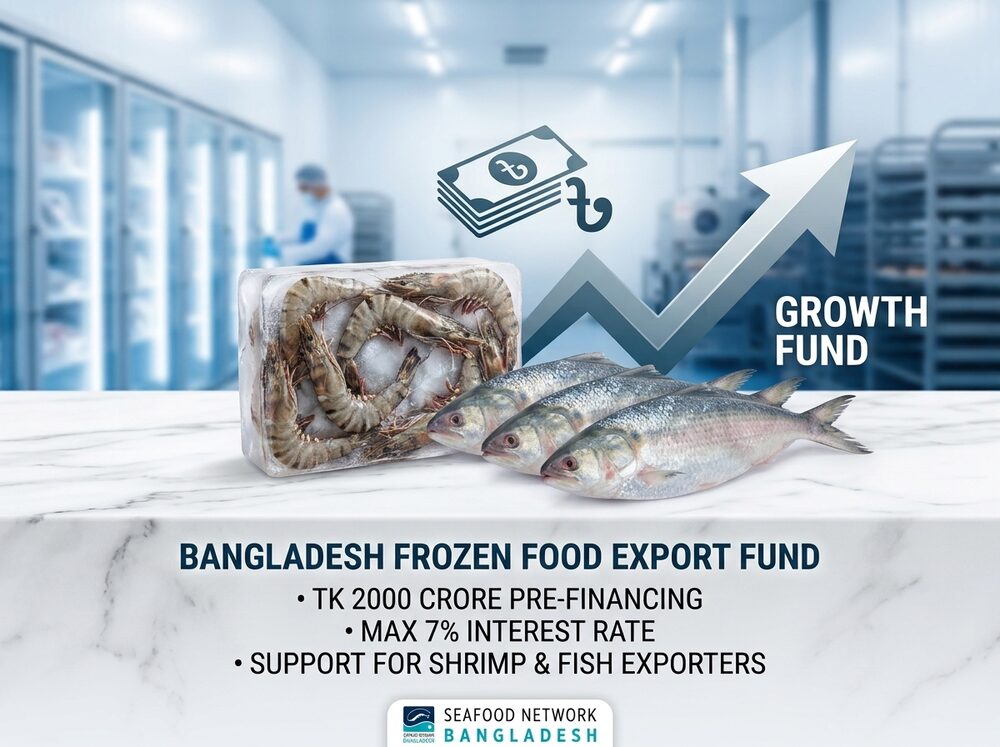
Bangladesh Bank has introduced a BDT 20 billion revolving pre-financing facility to strengthen Bangladesh’s frozen food export sector, with a particular focus on shrimp, fish and other frozen seafood products.
Under the new scheme, participating banks will receive funds from the central bank at an interest rate of 4 percent and can lend to eligible businesses at a maximum rate of 7 percent.
The three-year facility is designed to address some of the major financing challenges faced by exporters, including lengthy cash-conversion periods, rising inventory expenses, costly cold-chain operations and limited access to affordable credit.
Financing to Support Frozen Food Production and Export
According to a Bangladesh Bank circular, the fund will finance a broad range of activities linked to frozen food production and exports.
Eligible businesses can use the facility to purchase raw materials, process and collect shrimp and fish, modernize factories, acquire machinery and develop cold-storage infrastructure.
The financing will also support the reopening of closed or partially operational fish and food-processing plants. Solar energy projects and environmental improvement activities, including soil reclamation, are also covered under the scheme.
All scheduled banks operating in Bangladesh can participate after signing an agreement with Bangladesh Bank’s Agricultural Credit Department-2.
Loan Limits Set for Frozen Food Businesses
Bangladesh Bank has established different financing limits depending on the purpose of the loan.
New frozen-food factories can receive term loans of up to BDT 300 million, while existing processing plants can obtain up to BDT 200 million for renovation, expansion and modernization.
Companies can additionally secure financing for solar installations of up to BDT 50 million, or 30 percent of the main project loan, whichever is lower.
For working capital, businesses can borrow to cover raw-material purchases, production expenses, employee wages and utility bills. The amount will be assessed based on annual turnover, with a maximum ceiling of BDT 200 million.
Longer Repayment Period for Factory Investment
The scheme provides different repayment periods according to the type of investment.
For new factory projects, term loans may have a maximum tenure of seven years, including a grace period of up to one year.
Loans for renovation, expansion and modernization of existing facilities can be repaid over a maximum of five years, also including a one-year grace period.
Working-capital financing will initially be available for one year and can be renewed once. However, an individual borrower cannot receive working-capital support under the scheme for more than two years.
Priority for Struggling Export Factories
Bangladesh Bank has instructed participating lenders to give priority to frozen-food exporters whose factories are fully or partially closed because of working-capital shortages.
However, companies already receiving financing from another Bangladesh Bank or government program for the same purpose will not be eligible. Classified loan defaulters will also be excluded from the facility.
Although Bangladesh Bank will provide the pre-financing to participating banks, the lenders will carry the full credit risk and remain responsible for recovering the loans.
Banks that fail to repay the central bank’s pre-financed amount within the required period will face an additional 2 percent interest charge for the period of delay.
Solar Energy Requirement for Beneficiaries
The new facility also places emphasis on energy efficiency and renewable power.
Beneficiary businesses will be required to take measures to meet at least 15 percent of their electricity demand through solar power within two years.
Failure to meet the requirement could lead to suspension of further financing under the scheme.
Banks will also be required to monitor how loans are used and inspect borrowers’ factories or offices at least once every quarter.
New Push for Bangladesh’s Frozen Food Export Industry
The BDT 20 billion facility comes as Bangladesh seeks to strengthen its export-oriented frozen food and seafood processing industries.
By improving access to lower-cost financing, the initiative is expected to help businesses maintain inventories, upgrade processing facilities, expand cold-chain capacity and restart production at underutilized factories.
The scheme is also intended to support frozen food export growth, increase foreign-exchange earnings, create employment and generate greater economic activity in rural areas.
For Bangladesh’s shrimp and fish industry, improved access to working capital and investment financing could provide an important boost to production capacity and international market competitiveness.