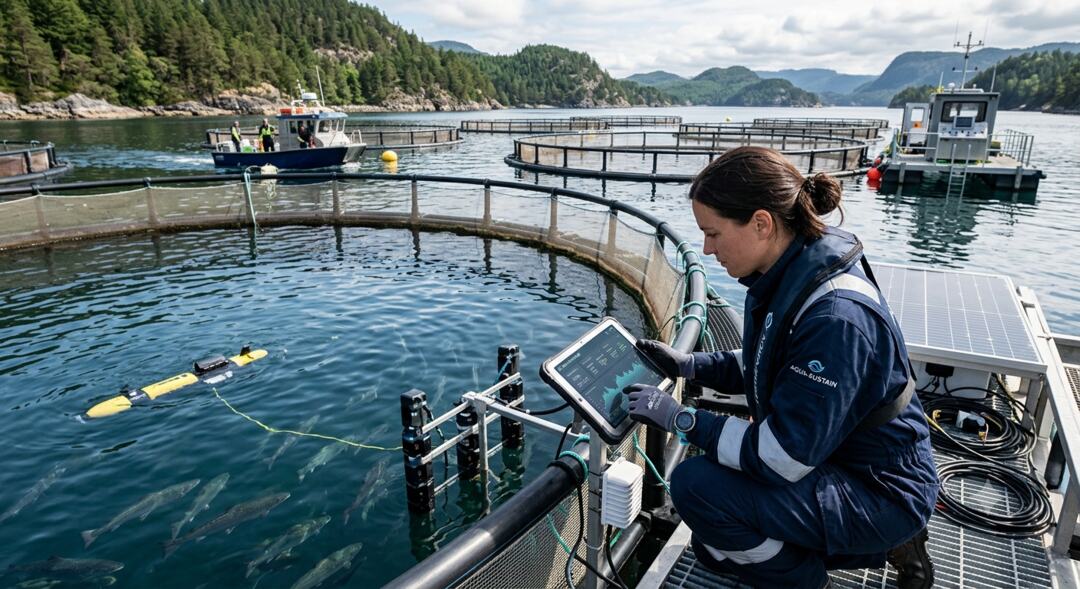
The global seafood industry is navigating an era of unprecedented transformation. Faced with the compounding pressures of climate change, biodiversity loss, and skyrocketing consumption, traditional, labor-intensive practices are no longer sufficient to secure long-term food safety and marine health. As wild capture fisheries face persistent challenges with stock depletion, aquaculture has stepped up, now providing more than half of the world’s seafood.
To match this growth with true ecological and economic sustainability, the aquaculture sector is undergoing a massive digital overhaul. Recent research reveals that the integration of Artificial Intelligence (AI), Machine Learning (ML), and the Artificial Intelligence of Things (AIoT) is rapidly transitioning from a theoretical horizon into operational reality-redefining how we monitor, manage, and scale farmed seafood.
Precision Aquaculture: The Rise of Digital Twins and Smart Feeding
Feeding represents one of the highest operational costs and environmental pain points in aquaculture. Overfeeding leads to water degradation and ecosystem pollution, while underfeeding harms fish health and growth efficiency. AI is bridging this gap through advanced automation.
Supervised machine learning pipelines are now being paired with digital-twin frameworks to revolutionize feed optimization. By simulating real-time farm dynamics, these digital models learn precisely when and how much to feed populations. Furthermore, reinforcement learning (RL) controllers are taking over complex recirculating systems, managing real-time water quality controls like dissolved oxygen forecasting and aeration adjustments.
On the structural side, computer vision systems are expanding coverage across farm infrastructure to automate automated biomass estimations, welfare assessments, and early disease detection. Instead of reactive management, producers can leverage short-horizon forecasting to identify stress behaviors and health anomalies before they escalate into costly outbreaks.
Computer Vision: Overcoming the Bottleneck of Manual Metrics
Accurate, continuous tracking of fish length, weight, and count numbers has historically been a critical operational bottleneck, requiring manual handling that stresses the animals and strains labor budgets. Modern breakthroughs in deep learning are dismantling these barriers.
Advanced vision architectures including YOLO (You Only Look Once) variants, Mask R-CNN, and ResNet models are demonstrating exceptional accuracy in automated tracking.
Operational Sizing: Deep convolutional networks like Mask R-CNN, when coupled with statistical models, have proven capable of automatically estimating the count numbers and mean fork lengths of specimens directly from high-resolution imagery. This type of non-invasive data extraction drastically increases sample sizes and removes human observation bias.
Automated Species and Biomass Tracking: In large-scale monitoring initiatives, cloud-based AI pipelines utilizing YOLOv4 and ResNet101 have successfully automated the identification of hundreds of marine species alongside automated length and weight measurements for tens of thousands of specimens.
Visual Tracking Under Real-World Conditions: Deploying Convolutional Neural Networks (CNNs) in combination with visual tracking systems enables automated, continuous counting. Researchers have noted that controlling variables such as lighting and weather by positioning cameras under covered structures allows automated counts to align highly accurately with manual controls.
At the Microscopic Level: eDNA and Genomic Innovation
The frontier of sustainable aquaculture extends beyond what the naked eye can see. AI-driven applications are making massive strides at molecular scales.
Environmental DNA (eDNA) metabarcoding has emerged as a highly sensitive, non-invasive diagnostic tool. By processing multi-species genetic material found in water samples, AI systems can map community compositions and pathogen presence with incredible precision. Crucially for farm operators, recent studies have confirmed a reliable positive correlation between eDNA concentration in the water column and the actual species biomass, providing an alternate avenue for automated abundance tracking.
Simultaneously, population genomics and advanced genome-editing techniques (such as CRISPR/Cas) are being optimized through machine learning algorithms. These technologies are targeting the selection of elite production traits and the enhancement of disease resistance, preparing farmed stocks to withstand climate volatility and shifting conditions.
Bridging the Operational Gap: Moving from Prototypes to Decisions
While the technological capabilities of AI are undeniable, researchers caution that a critical gap remains between data generation and operational decision-making. For AI to truly deliver on the promise of sustainability, systems must move beyond experimental, isolated prototypes and integrate into unified, operational decision frameworks.
A major component of this evolution is the necessity for calibrated uncertainty quantification. High-performing algorithms boasting “90% accuracy” are only as good as their reliability in unpredictable environments. AI systems that handle real-time control, such as reinforcement learning controllers adjusting aeration and feeding, must prioritize statistical uncertainty and model drift as core outputs to prevent systemic failures during extreme events.
Furthermore, the industry must actively address the structural inequalities in data access and technology adoption. While massive operations can easily deploy digital twins, smallholder producers often face prohibitive domain shifts, a lack of local labeled data, and high infrastructure costs. Overcoming these barriers requires standardized multi-region benchmarks, robust energy-efficient algorithms, and privacy-preserving data partnerships.
From Research to Reality: Vietnam’s AI-Powered Shrimp Farms
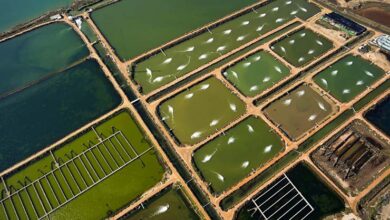
The practical value of AI is already becoming evident across Asia, particularly in Vietnam’s rapidly modernizing shrimp industry. Several commercial farms have begun integrating AI-enabled water quality sensors, automated feeders, and cloud-based monitoring platforms that continuously analyze parameters such as dissolved oxygen, temperature, pH, and ammonia levels. By combining real-time sensor data with predictive algorithms, farmers can optimize feeding schedules, reduce feed waste, detect environmental stress before it affects shrimp health, and respond more quickly to disease risks. These technologies have helped improve production efficiency while lowering operational costs and reducing the environmental footprint of intensive shrimp farming, demonstrating how AI can translate scientific innovation into measurable on-farm benefits.
Artificial intelligence is rapidly becoming one of the defining technologies shaping the future of sustainable aquaculture. By transforming vast streams of environmental, biological, and operational data into actionable insights, AI enables producers to optimize feeding, strengthen disease surveillance, improve animal welfare, and reduce environmental impacts. Yet technology alone cannot guarantee sustainability. Real progress will depend on high-quality data, affordable digital infrastructure, skilled personnel, and equitable access to innovation particularly for smallholder farmers in developing countries. As successful implementations in countries such as Vietnam demonstrate, AI is already moving beyond research laboratories into commercial aquaculture operations. With continued collaboration among researchers, technology developers, policymakers, and producers, artificial intelligence has the potential to become a cornerstone of a more resilient, efficient, and environmentally responsible global seafood industry.
Md. Shofiullah
Student, Department of Oceanography
Noakhali Science and technology University