Fisheries and Livestock Adviser Farida Akhter has said that the effective implementation of the “One Health” approach depends on close coordination among human health, animal health, and environmental management. She stressed that One Health cannot succeed unless these three areas work together in a unified manner.
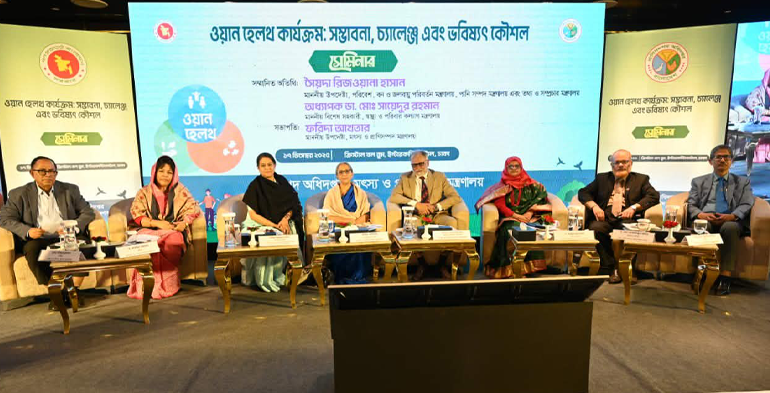
Adviser made the remarks while chairing a seminar titled “One Health Program: Opportunities, Challenges and Future Strategies”, organized by the Ministry of Fisheries and Livestock at Hotel Inter Continental on Wednesday afternoon.
The Adviser said presence of senior representatives from the ministries of Health and Family Welfare, Environment, Forest and Climate Change, and Fisheries and Livestock at the same table reflected a real commitment at the policy level. “Today we are not only discussing One Health as a concept, but moving forward together in practice,” she said.
She emphasised that One Health should not remain a topic for speeches alone. “It requires real political commitment, policy alignment, and a willingness to work together. The era of fragmented action is over. What we need now is a whole-of-government and whole-of-nation approach,” she added.
The adviser pointed out that while people suffer from diseases, human actions often create health risks. Unsafe food, environmental pollution, excessive use of antibiotics, and unplanned urbanisation are major contributors to rising health threats. She stressed the need to prioritise prevention and strengthen primary healthcare to address these challenges.
She also highlighted that climate change, zoonotic diseases, food safety, and public health are closely linked. In response, the government has decided to implement the proposed One Health initiative through a single Development Project Proposal (DPP), jointly managed by the three ministries, with three project directors to ensure coordinated implementation across sectors.
Expressing optimism, Farida Akhter said that by considering human health, livestock, fisheries, and the environment together, Bangladesh would be able to implement One Health effectively and set a strong example for other countries.
Speaking as an honoured guest, Adviser for Environment, Forest and Climate Change, Water Resources, and Information and Broadcasting Syeda Rizwana Hasan said development planning must place environmental protection, biodiversity, and public health at its core. She warned that environmental destruction in the name of development ultimately harms society. “We can build roads and infrastructure, but we cannot recreate the Sundarbans or restore a river once it is destroyed,” she said.
She noted that climate change, pandemics, and environmental crises continue to remind us that all elements of nature are deeply interconnected. “Humans are not owners of nature; we are part of it,” she said.
Rizwana Hasan also identified major obstacles to implementing One Health, including excessive procedural complexity, weak coordination among ministries, and delays in decision-making. She called for the formation of effective advisory committees at national and district levels, along with clearly defined focal points in each ministry.
Another honoured guest, Professor Dr Md Sayedur Rahman, Special Assistant to the Chief Adviser at the Ministry of Health and Family Welfare, said that human health must remain central to the One Health approach. He explained that the importance of fish, livestock, and environmental health ultimately lies in their impact on human health, food safety, and livelihoods.
Describing the proposed One Health project as an “eye-opening” initiative for Bangladesh, he said it aims to build the capacity to detect health risks early and respond in a timely manner by viewing people, animals, and nature through a single integrated framework.
A joint keynote presentation on One Health was delivered by IEDCR Director Professor Dr Tahmina Shirin, Deputy Chief Conservator of Forests Md Zahidul Kabir, and Director General of the Department of Livestock Services Dr Md Abu Sufian.
The seminar was also attended by Planning Commission Member (Secretary) Dr Kaiyum Ara Begum, Health Services Division Secretary Md Saidur Rahman, Environment Ministry Secretary Dr Farhina Ahmed, and Planning Commission Member (Secretary) for Agriculture, Water Resources and Rural Institutions Dr Md Mostafizur Rahman. Secretary of the Ministry of Fisheries and Livestock Abu Taher Muhammad Jaber delivered the vote of thanks.